

Picture a college campus filled with thousands of students: Crowds form in the quad and library, yet many feel profoundly alone. This paradox exists in institutions across the country. Students move through their routines surrounded by potential friends and communities, but interactions fall short of real connection. Rather than a problem of motivation, this phenomenon represents a structural failure embedded in the very technology meant to bring students together.
Meanwhile, a nationally representative survey of first-year U.S. college students reveals “a strong sense of belonging motivated students to access campus resources, enhanced social support, and led to better academic performance.” Lack of belonging on campus drives serious institutional outcomes, from poor retention rates to declining mental health and academic performance. While these statistics surface a troubling reality, meaningful opportunities exist to boost connection and success.
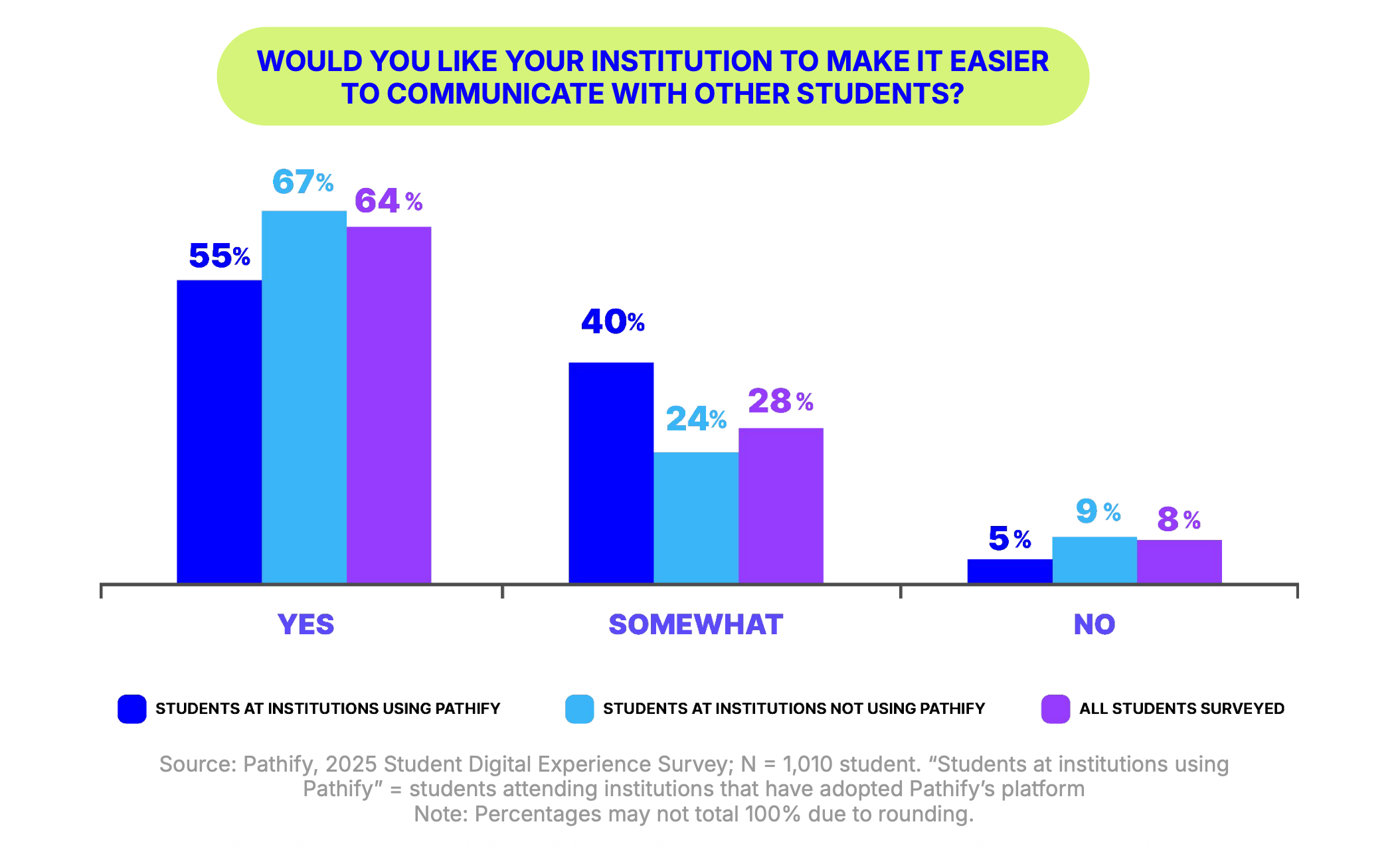
Pathify’s 2025 Student Digital Experience Survey reveals the demand for connection: 64% of students would like their institution to make it easier to communicate with other students. Students seek community, but disjointed digital experiences often hinder rather than encourage those connections — leaving students unaware of important information about clubs and events, and lacking safe, managed digital forums to meet their peers.
Today’s campus technology often features fragmented portals across disconnected platforms and apps. Students consistently juggle their LMS, email, various apps, and outdated systems, creating barriers rather than pathways to connection. Digital natives who grew up with seamless, intuitive apps now rely on flyers and word of mouth to find campus communities — illustrating the communication gap directly eroding belonging.
The Communication Gap
If 64% of students want better ways to connect, why doesn’t institutional tech serve as the primary bridge? The reality shows a massive disconnect: Only one-third of students actually use school-provided platforms to find groups, leaving the vast majority to rely on analog relics like word-of-mouth and paper flyers.
Todayʼs digital ecosystem fails to act as the primary hub for discovering and participating in the digital campus. Unless students happen to walk past a bulletin board or sit next to the right person in class, they miss out entirely. Meanwhile, even the third who do use institutional tech often face clunky platforms lacking personalized feeds and targeted information. When finding community becomes a matter of luck, students miss the connections that make campus feel like home.

The Silent Campus Effect
When students encounter boundaries to finding community, they stop looking. The effort begins to feel futile, turning campus into a place they pass through rather than a place they belong. Still, their desire for discovery and connection persists — in our survey, a resounding 65% of students reported wanting easier ways to find out about groups and clubs. That’s nearly two-thirds of students actively seeking connection, but hitting dead ends.
The “silent campus” effect offers a wake-up call to institutions. Belonging isn’t a nice-to-have feature — it’s a crucial retention metric. When institutional technology fails to provide a simple, intuitive communication channel, the resulting friction exacerbates the isolation crisis. The gap between what students ask for and what institutions provide proves more than a tech problem — it represents a real barrier to belonging.

Belonging: The Hidden Driver of Student Success
The traditional college experience represents key developmental milestones: the newfound independence, the sense of discovery, the late-night friendships. But in the modern era, the college experience is no longer confined to the quad — it lives on the screen. Today, the digital experience is the student experience, and failing to deliver drives a massive enrollment liability.
A staggering 32% of current students say they would reconsider their choice of institution if the decision were based solely on the quality of digital systems. When paired with the data showing a mere 28% of students use their institution’s community app to communicate with peers, it reveals a clear disconnect. A true “single pane of glass” digital experience accomplishes more than just checking grades — it bridges the gap to connection, belonging and community. When an institution makes it easy for students to find their people, it creates the stickiness that drives persistence, well-being and academic success.

The Campus Experience Platform (CXP) Advantage
Students don’t need or want more tools – they want one unified platform, and institutions must prioritize fundamental changes to their technology strategy in order to deliver. When information, communication and community live in disconnected systems, connection becomes harder to find. With a unified experience, it happens naturally.
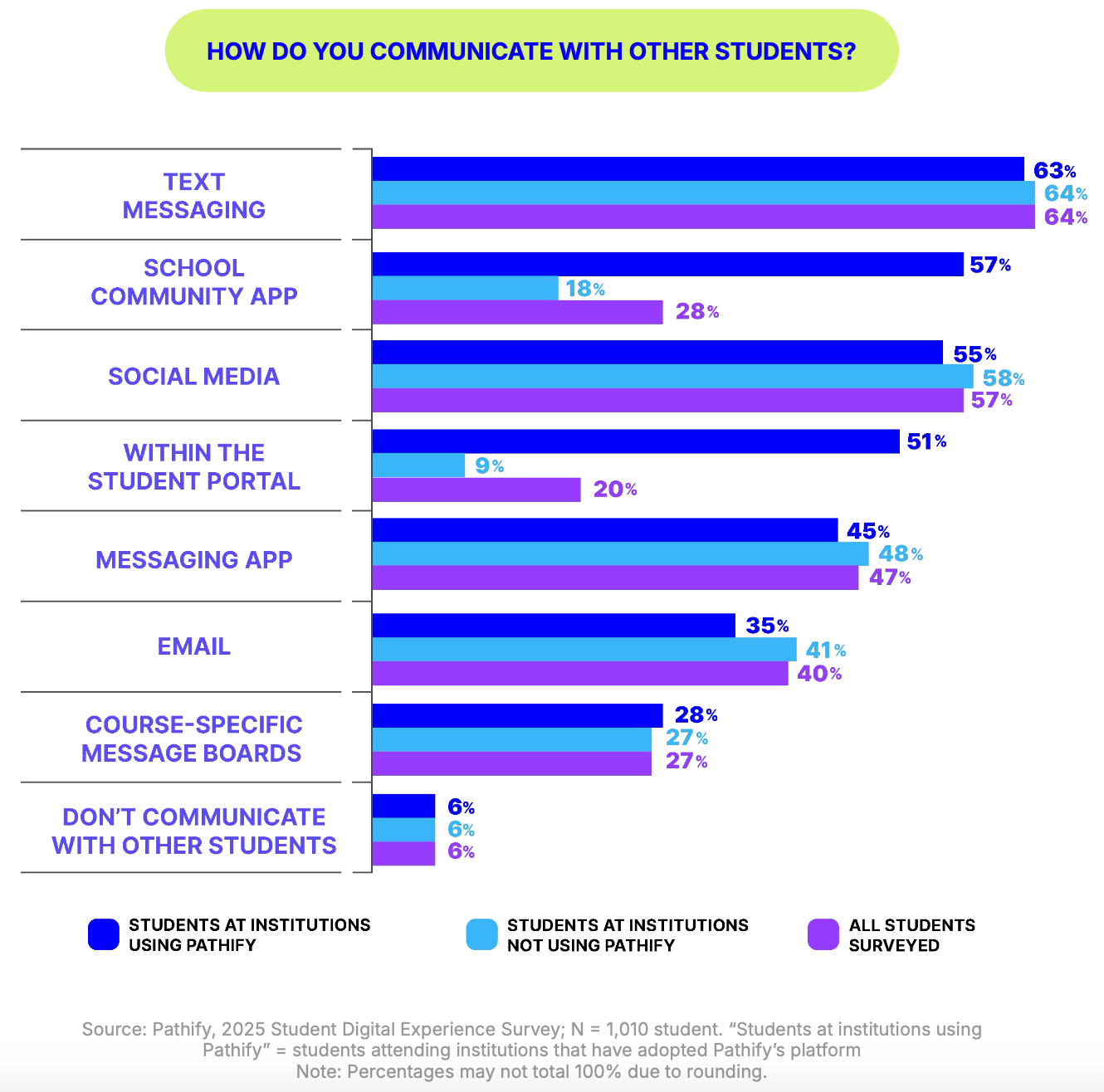
Students using Pathify are far more likely to use their institution’s app for peer-to-peer communication: 57% compared to just 18% at institutions without a seamless digital platform. This gap shows the dramatic difference streamlined technology makes on students’ ability to connect. A unified experience eliminates friction and gives students a place to engage safely. By adopting a CXP, institutions unlock a powerful tool to tackle the lack of community and increase belonging on campus.
To explore the full scope of the data – and the solutions enabling institutions to foster community and improve retention — download the full 2025 Pathify Digital Student Survey.
Click here to access the full 2025 Pathify Digital Student Experience Survey.